
Lille, France | 4–5 November 2025
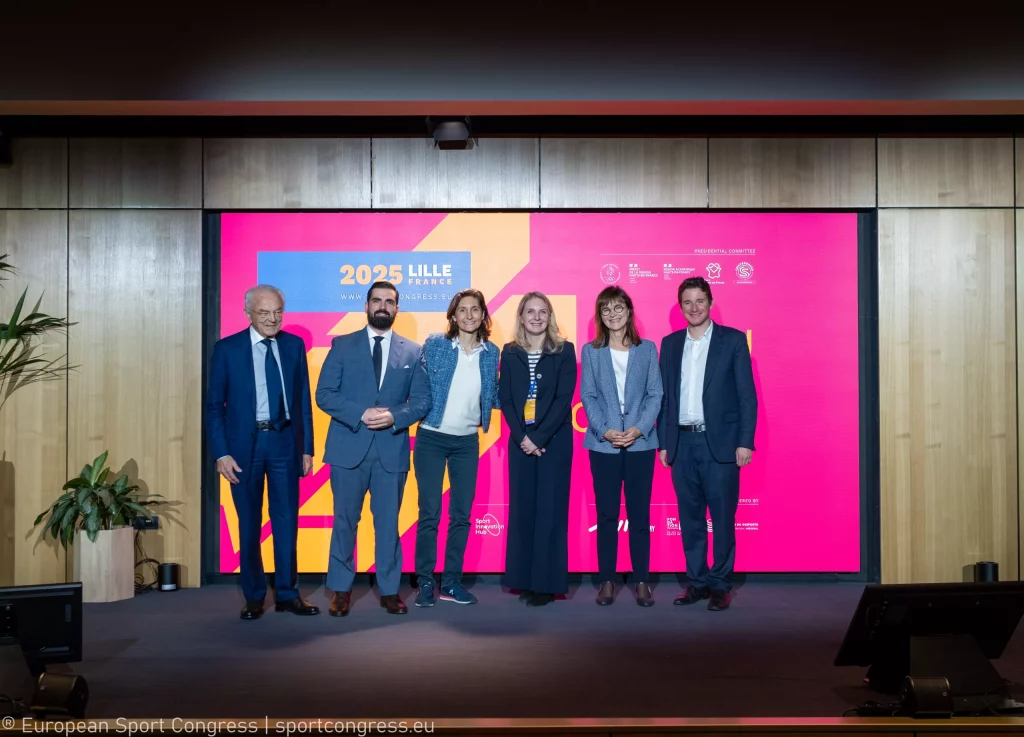
The second edition of the European Sport Congress (EUSC) took place in Lille, France, on 4 and 5 November 2025 — and it delivered two days of ideas, debate, and connection that reinforced why this event has quickly become a landmark in the European sport calendar.
Hosted at Le 1894 in the heart of Lille and co-organised with French sport organisation 135BPM, this year’s congress built on the momentum of the inaugural 2023 edition in Gijón. With Sport Innovation Hub proud to serve as a powering partner, the event brought together researchers, institutions, policymakers, and practitioners from across Europe to disseminate Erasmus+ Sport-funded projects, forge new partnerships, and tackle the pressing challenges facing the sector.
A Programme Built Around Impact
The opening ceremony set the tone for an ambitious two days. Amélie Oudéa-Castéra, President of the French National Olympic and Sports Committee, underlined Lille’s significance as host: one year on from the Paris 2024 Games, the city provided the ideal backdrop for channelling national sporting energy into a broader European conversation around youth, innovation, and cross-border cooperation.
From there, the programme moved through a rich mix of keynotes, labs, and project communications. Rodrigo Garza of the International Olympic Committee opened the session track by presenting the Athlete365 Business Accelerator Programme — a compelling case for how elite athletes can transition into entrepreneurship with the right support structures in place.
Inclusion featured prominently throughout both days. Kateryna Lavryk from the Council of Europe presented the outcomes of the ongoing Sport For All initiative, a joint EU-Council of Europe project working to protect access to sport as a human right for people with disabilities. The message was clear: grassroots visibility and systemic policy change must go hand in hand.
Innovation and the Future of Sport
Sport Vlaanderen’s Tommy Maenhaut and Brecht De Vos offered a thought-provoking look at why even small public agencies must invest in innovation — and shared details of their ambitious ‘Matchmaking’ project, aiming to digitally connect sport supply and demand at scale, a solution the sector has long been missing. Decathlon’s Head of Innovation Excellence, Matthieu Cesano, complemented this with a practitioner’s view of embedding innovation across every stage of the product and programme lifecycle.
The hands-on labs were among the most engaging moments of the congress. Lab sessions on sport as a tool for social inclusion (led by Ricardo Carvalho of Social Innovation Sports) and youth employment through the “Stadium to Employment” programme ran twice over to meet demand — a sign of how practical, replicable models resonate with this audience.
Athletes, Coaches, and Long-Term Well-being
Day two broadened the lens to encompass athlete welfare, coach education, and physical education policy. Dr. Daniela Heerdt of Asser Instituut delivered a keynote on embedding human rights frameworks into sport governance, while Prof. Sergio Lara-Bercial traced the journey of the ICOACHKIDS project from an Erasmus+ grant to a global movement for child-centred coaching.
The congress closed with a roundtable on the STARS project (Shaping Talents and Achieving Vocational Excellence in Sport) — an Erasmus+ Centre of Vocational Excellence co-led by Sport Innovation Hub — bringing together partners from ministries, sport federations, and vocational education providers to discuss skills gaps, dual career pathways, and the future of the sport workforce.
Looking Ahead
EUSC 2025 reinforced something the sport innovation community already knows: the most transformative projects don’t speak for themselves. They need spaces to be shared, challenged, and scaled. The European Sport Congress is becoming exactly that space.
We look forward to EUSC 2027 — and to continuing to support the network that is shaping the future of sport across Europe.
Sport Innovation Hub is a powering partner of the European Sport Congress. Learn more at sportcongress.eu.
Proyecto cofinanciado por el Ayuntamiento de Gijón/Xixón a través de Gijón Impulsa en el marco de la convocatoria de subvenciones Diversificación de Mercados 2026.